Loading...
Jan Jan 14, 2020

Surgery with Music Series: Post #11 Spotlight on Music Therapy Researcher, Deforia Lane


By |January 14, 2020|30-day blog series, Premier Music Therapy Researcher|0 Comments

FacebooktwitterpinterestlinkedinmailFacebooktwitterpinterestlinkedinmail

One of the first music therapists that I ever met was a lady named Deforia Lane. Deforia had just taken her PhD dissertation defense and she was feeling very relieved.  This was mid-1990 and I had just met my soon-to-be mentor, Arthur Harvey, DMA.  Arthur was presenting a workshop in Cleveland and invited me to go with him to see how he presents.  Deforia joined us at the very end of the workshop and I could tell that she was extremely passionate about music therapy and about music therapy research.  Her PhD dissertation had to do with testing salivary iGA (immuno-globulin, in patients that had just had a music therapy session.  I believe that her research showed that the music therapy session did increase the amount of salivary iGA, which means it does boost the immune system.

This was almost 30 years ago and since then, Dr Deforia Lane has conducted many ground-breaking studies on different aspects of music therapy.  One of her most recent stories has to do with music therapy before surgery with women diagnosed with breast cancer.  Listen to her talk about how this study played out: (video starts with one of Dr Lane’s colleagues singing the patients favorite song, before she is taken into surgery.)

I have met with Deforia Lane many times as of 2020, and have found her to be a dynamic speaker, an approachable researcher, and a compassionate clinician.  One of my favorite videos of her working with children  here

In addition to her research and clinical work, Dr Lane is a much-in-demand speaker who has done numerous Ted Talks around the country.   I’ll leave you with one final video of one of my heroes, Deforia Lane:

I hope you’ve enjoyed this blog post and will leave me some comments and questions!

FacebooktwitterpinterestlinkedinmailFacebooktwitterpinterestlinkedinmail
Jan Jan 13, 2020

Surgery and Music Blog Series, Post #10: A look at the Meta-analysis of 100’s of Studies

By |January 13, 2020|30-day blog series, Surgical Serenity Research Study, Surgical with Music on National TV|0 Comments

FacebooktwitterpinterestlinkedinmailFacebooktwitterpinterestlinkedinmail

You may have heard of a meta-analysis.  It’s when scientists and researchers looks at hundreds of studies that have been done on a specific issues, or even just an aspect of that issue.  For example, researchers have looked at hundreds of studies that were done on Surgery with Music, one looking at anxiety reduction, and another looking at a reduction in pain perception.  Then they distill the most important imformation from the study and publish it.

In 2015, the prestigious British Medical Journal, “The Lancet” published an important meta-analysis:

https://www.thelancet.com/journals/lancet/article/PIIS0140-6736(15)60169-6/fulltext

This publication garnered so much attention world-side, that I got at least a dozen notifications that this study had come out around the world.  The final summary states,

Summary

Background

Music is a non-invasive, safe, and inexpensive intervention that can be delivered easily and successfully. We did a systematic review and meta-analysis to assess whether music improves recovery after surgical procedures.

Methods

We included randomised controlled trials (RCTs) of adult patients undergoing surgical procedures, excluding those involving the central nervous system or head and neck, published in any language. We included RCTs in which any form of music initiated before, during, or after surgery was compared with standard care or other non-drug interventions. We searched MEDLINE, Embase, CINAHL, and Cochrane Central. We did meta-analysis with RevMan (version 5.2), with standardised mean differences (SMD) and random-effects models, and used Stata (version 12) for meta-regression. This study is registered with PROSPERO, number CRD42013005220.

Findings

We identified 4261 titles and abstracts, and included 73 RCTs in the systematic review, with size varying between 20 and 458 participants. Choice of music, timing, and duration varied. Comparators included routine care, headphones with no music, white noise, and undisturbed bed rest. Music reduced postoperative pain (SMD −0·77 [95% CI −0·99 to −0·56]), anxiety (−0·68 [–0·95 to −0·41]), and analgesia use (−0·37 [–0·54 to −0·20]), and increased patient satisfaction (1·09 [0·51 to 1·68]), but length of stay did not differ (SMD −0·11 [–0·35 to 0·12]). Subgroup analyses showed that choice of music and timing of delivery made little difference to outcomes. Meta-regression identified no causes of heterogeneity in eight variables assessed. Music was effective even when patients were under general anaesthetic.

Interpretation

Music could be offered as a way to help patients reduce pain and anxiety during the postoperative period. Timing and delivery can be adapted to individual clinical settings and medical teams.
Excited journalists from the around the world contacted me to make sure that I knew about this.  This was a huge moment for Surgical Serenity Solutions because of major validation from this meta-analysis.
Shortly after this publication, NPR did a piece on this study and how important it was in the time of the opioid crisis.  Listen to it here:
If you’re interested in knowing more about some of the many meta-analyses that have been done on Surgery with Music, simple Google the topic and read the many clinical topics.  The NPR page goes on to say:

DAVID GREENE, HOST:

There is a free and powerful treatment hospitals could probably be using more often to treat patients who have surgery. It’s music. Scores of studies have looked at the power of music to ease this kind of pain. NPR’s Richard Harris reports on new research that pulls many of these findings together.

RICHARD HARRIS, BYLINE: When researchers in London started combing through the medical literature for studies about music’s healing powers, they found hundreds of small studies suggesting some benefit. The idea goes back to the days of Florence Nightingale. And music was used to sooth surgical pain as early as 1914. Dr. Catherine Meads at Brunel University focused her attention on 73 rigorous, randomized clinical trials about the role of music among surgery patients.

CATHERINE MEADS: As the studies themselves were small, they didn’t really find all that much. But once we put them all together, we had much more power to find whether music worked or not.

HARRIS: She and her colleagues now report in The Lancet that, yes indeed, surgery patients who listen to music, either before, during or after surgery, were better off.

MEADS: Reduced pain and less anxiety and better patient satisfaction.

HARRIS: Remarkably, patients listening to music used significantly less pain medication. Meads says music on average helped them to drop two notches on the 0-to-10 pain scale. That’s often what you’d get with a dose of medicine. Music in place of heavy-duty pharmaceuticals is a good trade-off. And we’re not just talking Mozart or Yanni. Music in many of these studies was whatever patients chose for themselves.

(SOUNDBITE OF MUSIC)

MEADS: I didn’t think it mattered at all which sort of music it was. It could be anything from Spanish guitar to Chinese classical music.

HARRIS: Was there any downside?

MEADS: Doesn’t seem to have any sort of side effects or anything like that.

HARRIS: Well, maybe one. A few other studies have noted that operating rooms are very noisy places, and added music can make it harder for the surgical staff to hear what’s going on. Doctors sometimes have to repeat their commands, creating opportunities for misunderstanding.

MEADS: If surgeons are listening to music, it can be a bit of a distraction. So it may be it’s not such a wise idea to have it during the operation itself.

HARRIS: That was not, however, something Meads analyzed in her study of music and medicine. Richard Harris, NPR News.

FacebooktwitterpinterestlinkedinmailFacebooktwitterpinterestlinkedinmail
Jan Jan 12, 2020

Surgery with Music Series, Post #9: Clinical Research on the Surgical Serenity Headphones and Therapeutic Music

By |January 12, 2020|30-day blog series, Surgical Serenity Research Study|0 Comments

FacebooktwitterpinterestlinkedinmailFacebooktwitterpinterestlinkedinmail

Scientists and music therapists have been conducting research on Music with Surgery for a long time.  Most of these studies are looking for specific information like whether or not there is a reduction in anxiety or pain perception.  These two things in particular have been studies with all kinds of surgeries.  Most recently there have been many studies on joint replacements, breast cancer surgeries, and diagnostic tests such as colonoscopies and endoscopies.

One of the questions that I am asked a lot is whether or not there has been a clinical study on the Surgical Serenity Solutions headphones and music.  I am very happy to report that there has been a study, conducted here at the V.A. Hospital.  The study looked at men between the ages of 18-72 who were having major abdominal surgery.  The study was conducted by Dr. MarinaVarbanova, an anesthesiologist there at the VA hospital.

In conversation with Dr Varbanova, I asked her about whether the subjects were all OK with classical piano miniatures since we know that not everyone likes classical music.  She explained that she told the subjects that this music was the best music to engage rhythmic entrainment, which would affect their anxiety and pain perception.  Only one subject decided to withdraw from the study because he only wanted country music.  At the conclusion of the study, results indicated a 20% reduction in anxiety and pain perception.  We were really thrilled with this result.  In a period of history where opioid addiction is killing thousands of people, the reality that music through headphones can be used to soothe and calm patients is truly exciting!

I am attaching to this blog post both the published study and the Powerpoint presentation that was given to staff at the VA Hospital.

Our SSS study

V.A. Hospital in Louisville, KY


Surg Serenity VA Hospital Pt. Evaluation

FacebooktwitterpinterestlinkedinmailFacebooktwitterpinterestlinkedinmail
Jan Jan 11, 2020

Surgery with Music Series, Post #8: Research in Surgery with Music: where does it come from?

By |January 11, 2020|30-day blog series|0 Comments

FacebooktwitterpinterestlinkedinmailFacebooktwitterpinterestlinkedinmail

There are literally hundreds of studies on the use of music with surgery.  These studies date back more than 50 years, but I’d say that the bulk of them have been done in the past 25 years.  The come from the fields of medicine, surgery, neurosurgery, nursing, psychiatry, music therapy, music medicine, and holistic medicine.  There have been many meta-analyses done (after the fact, of course) on numerous different aspects of music and surgery studies.

Many of these studies refer to “music therapy and surgery” when really it is music medicine and surgery.  Many people think that music therapy and music medicine are synonymous but they really are quite different.  In order for music therapy to be done, a Board-certified music therapist must be present.  The music therapist must be present with the patient when the intervention is done and form a therapeutic relationship with the patient, learning a little bit about what kind of music the patient likes and understanding a little about their emotional state.

In the field of music medicine, the music is the intervention and can be implemented without a music therapist being present.  In the case of the Surgical Serenity Solutions, the music has been chosen and sequenced over a period of many years before I had the idea to put this music on cordless, programmable headphones.  Instead of a music therapist, I am a musicologist, a clinical social worker, and a concert pianist.  I’ve had a very unusual career path, but it put me in the perfect condition to do the very work that I am doing today.

Since I’ve mostly been talking about cataract surgery this past week, I thought I would focus on a research study about Music with Cataract Surgery.

Music for the eyes: Music helps before surgery

Date:
May 27, 2016
Source:
ESA (European Society of Anaesthesiology)
Summary:
Having relaxing music played just before eye surgery leads to patients feeling less anxiety and requiring less sedation, concludes a new study.

Having relaxing music played just before eye surgery leads to patients feeling less anxiety and requiring less sedation, concludes a study presented at Euroanaesthesia 2016 (London, 27-30 May). The study is by Dr Gilles Guerrier, Cochin University Hospital, Paris, France, and colleagues.

Awake eye surgery is particularly stressful for patients. Music has long been known to reduce anxiety, minimise the need for sedatives, and make patients feel more at ease. The purpose of this pilot study was to evaluate the effect of music on anxiety in outpatients undergoing elective eye surgery under topical (local) anaesthesia.

A total of 62 patients were prospectively and randomly assigned to hear relaxing music or no music through headphones for around 15 minutes just before cataracts surgery, which also lasted an average 15 minutes (all patients had the same type of surgery to make the results comparable).

The music played was specifically composed to ease anxiety following strict criteria, including instrumental pieces only using a decreasing tempo and a progressive decrease in the number of instruments playing. Each patient was able to choose from a panel of 16 recorded music styles according to their own preferences, and listened through high quality headphones. There were various styles available, including jazz, flamenco, Cuban, classical and piano. The music was provided by MUSIC CARE, a Paris-based company that produces music aimed at preventing and managing pain, anxiety and depression.

Due to the massive use of disinfectant and other liquids during surgery, headphones would have been rapidly damaged if used during the actual procedure. However, there is evidence that music-induced relaxation lasts around 60 minutes after the music has stopped.

A surgical fear questionnaire (SFQ) was used to assess anxiety before and after a music session. Overall postoperative patient satisfaction was assessed using a standardised questionnaire. The proportion of patients receiving the sedative midazolam during surgery was also recorded.

The researchers found that significant differences were noted between groups in anxiety VAS after music session, with anxiety significantly reduced among the music group (score 23 out of 100) compared to the non-music group (score 65 out of 100). The music group also received significantly less sedatives during surgery compared with the non-music group (16% vs 32%). Postoperative satisfaction was significantly higher in the music group (mean score 71 out of 100 versus 55 for the non-music group).

Dr Guerrier says: “Music listening may be considered as an inexpensive, non-invasive, non-pharmacological method to reduce anxiety for patients undergoing elective eye surgery under local anaesthesia.”

He adds: “The objective is to provide music to all patients before eye surgery. We intend to assess the procedure in other type of surgeries, including orthopaedics where regional anaesthesia is common. Moreover, post-operative pain may be reduced by decreasing pre-operative anxiety, which is another study we intend to perform.”

FacebooktwitterpinterestlinkedinmailFacebooktwitterpinterestlinkedinmail
Jan Jan 11, 2020

Surgical Serenity Blog Series, Post #7: Looking back on how music helped me navigate my cataract surgery

By |January 11, 2020|30-day blog series, Cataract Surgery with Music|1 Comment

FacebooktwitterpinterestlinkedinmailFacebooktwitterpinterestlinkedinmail

I’m hoping that you’ll excuse me for not doing a video every day with my blog post as I said that I would.  After having cataract surgery on Wednesday morning, I’m just not looking as bright and perky as I’d like to and so I’ll just use some still photos that others are taking to help me follow this process.  Yesterday was the first day post-op and I felt pretty good although a little tired from all of the Versed that they gave me.  Thinking about the music through the two different headphones that I used, I know that I would have been waayyy more anxious without it.  I could feel my breathing particularly, relax and slow down when I would put the headphones on.  I actually used both types of pre-loaded headphones at different points during the surgery, but decided on the “patient model” to wear into the cataract procedure.  The reason was just the simplicity of turning it off and on and they volume was already adjusted perfectly for me.

About 4 years ago, I had taken a friend for cataract surgery at this very same SurgeCenter and had to do much more explanation of what the headphones were about and that they had been specifically created for surgery to lower anxiety and pain perception.  This time, I didn’t have to explain anything to anyone.  On the contrary, they were asking me questions about how I like them, where I got them, and if other hospitals and doctors in Louisville were also using them!!  When I explained that Drs around the world are using not only the headphones but also the surgery playlists with Bluetooth headphones.  So yesterday for the first cataract surgery was a big success and a way for me to benefits for the healing power of music, get my vision sharpened up again, and tell people around the world about not only the two models of headphones, but also our five mobile apps, www.surgicalserenitysolutions.com/buyanapp, and our new ebook on surgery:

preparing for surgery

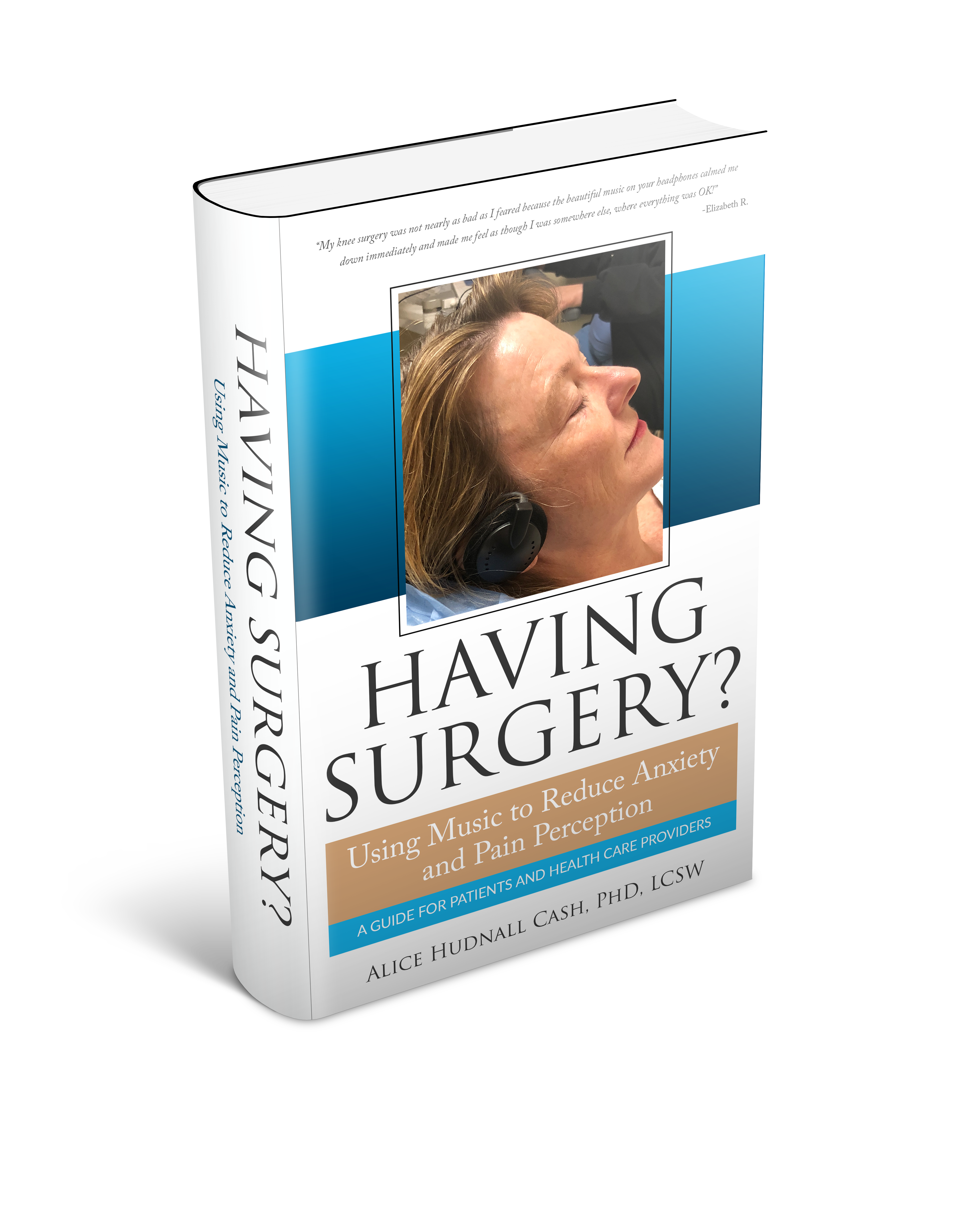
Dr Cash’s book on surgery is available in the Kindle bookstore on Amazon for $9.99.  It will soon be available in hard copy on Amazon, as well!

FacebooktwitterpinterestlinkedinmailFacebooktwitterpinterestlinkedinmail
Jan Jan 10, 2020

Surgery Music Series: Day #6 Cataract Surgery with Music

By |January 10, 2020|30-day blog series|0 Comments

FacebooktwitterpinterestlinkedinmailFacebooktwitterpinterestlinkedinmail

I couldn’t post this yesterday because I was having eye surgery but I did document the procedure throughout the day and here are the pics!  This was the first time I’ve had surgery in about 26 years and my first time to use the Surgical Serenity Solutions headphones during surgery.  The procedure was cataract surgery on the right eye with replacement with a multi-focal lens.  It was supposed to be a very simple procedure, but as I said in the Day 5 blog post and video, just the thought of not being able to respond while someone works on my eye with a scalpel, was a little bit terrifying, so I knew that I needed the soothing serenity music in addition to their Versed.

When I first got there yesterday morning, it was still dark and cold outside, so here I am in the lobby of the Surge Center:  Shortly  after  this  photo,  they  summoned  me  to go  back  and  be  prepped  for  surgery.  The  very  kind  and  patient  pre-surgery  nurse  helped  me  out  of  my  clothes  and  into  my gown,  asked  me  lots  of  questions  and  then  I put  on  my  headphones  and  started  relaxing  to  the  beautiful  music.


After waiting for what seemed like an eternity and still being wide-awake, I thought I would make a little video for you:  Here is the brief video that I made, and almost immediately after this I was wheeled into surgery;

IMG_0244

The cataract surgery didn’t take more than 20 minutes, if that.  From the moment it was over, I didn’t remember a thing about it even though I was not given a general anesthesia.  I was given the drug Versed which makes you very relaxed and makes you not remember anything.  I know that the music was playing the entire time and the team was able to do their work quickly and accurately.


I spent most of the rest of yesterday sleeping comfortably.  Here’s is the documentation of that.  The  staff  at  the  surgery  center  were  all  fascinated  by  the  headphones  and  wanted  to  know  all  about  their  history  and  where  they  could  purchase  them.  I’ll  continue  more  about  this  tomorrow.


FacebooktwitterpinterestlinkedinmailFacebooktwitterpinterestlinkedinmail
Jan Jan 7, 2020

Surgery with Music Blog Series, Day 5: Preparing to have surgery with music

By |January 7, 2020|Preparing for Surgery Using Music, Surgery Headphones Options, Surgical Anxiety|0 Comments

FacebooktwitterpinterestlinkedinmailFacebooktwitterpinterestlinkedinmail

Tomorrow I am having surgery.  Am I anxious and afraid of experiencing pain?  The answer is absolutely “YES!”  Who can bravely walk into a surgery facility without their heart racing and their mind going through a list of “what-ifs?”  Not me.  Of course I trust my doctor to know exactly what she’s doing.  Of course I want my vision to be lots better because it has seriously deteriorated recently.

So how am I preparing for my cataract surgery?  I am literally doing everything possible to make sure that my experience tomorrow goes as smoothly as possible and that my 24 hours of complete rest and inactivity is as pleasant as possible.  I’ve been cleaning the house like crazy so that when I’m lying on the couch my view will be calm and pleasant.  I’ve bought some of my favorite simple to digest foods, like eggs and simple soups, yogurt and good bread.  Of course I have lots of coffee, tea, and hot chocolate.

But the biggest thing will be the music that I take with me.  Of course I have lots of choices.  I have both models of our Surgical Serenity Solutions headphones with our classical playlist pre-loaded onto the headphones.  They will play continuously  for 8-10 hours and I will put them on as soon as I check in at the surgery center tomorrow morning at 7 a.m.  I will be working on this blog post throughout the day to document to you and for myself, how my feelings go through this day.

It’s now almost 3:30 PM EST and I’m going to have to finish this post up.  I still have 3 Therapy sessions to conduct today with other people and I want to get to bed by 10 PM in order to be at the Surgery Center tomorrow by 7:15 AM.  I will make an actual video of myself now, explaining the two pre-loaded models of headphones available as will as showing how the mobile app works with Bluetooth headphones.  If possible, I will do a live video from the pre-op area tomorrow but probably not the cataract procedure room and almost certainly not from the recovery area. Please say a prayer for me tonight for calm and serenity both tonight and healing for tomorrow.  The Dr will be inserting a tri-focal lens into each eye after removing the cataract.

FacebooktwitterpinterestlinkedinmailFacebooktwitterpinterestlinkedinmail
Jan Jan 6, 2020

Day 4 of Music with Surgery Blog Series: Treating Anxiety and Pain Perception

By |January 6, 2020|Anxiety and Pain Perception, Cataracts, Downloadable playlists now available|0 Comments

FacebooktwitterpinterestlinkedinmailFacebooktwitterpinterestlinkedinmail

This week we are looking at the many reasons that people use music with their surgeries.  For me, the reason has always been to ease anxiety and to decrease pain perception so that I don’t have to use any more pain medication than is absolutely necessary.  If course I don’t want to feel pain, but I also don’t want to be dependent on or addicted to opioid medication.

It’s not that the Drs don’t know how to prescribe these medications safely, but some people are just inherently prone to addiction.  There seems to be a true genetic tendency that is passed down in families and if that’s the case with your family, you might want to look into whether music will be an option for you!

As it turns out, I will be having surgery myself in less than 48 hours!  Will I be using music?  Of course!!  I’m having cataract surgery this Wednesday morning, January 8, as well as next Wednesday morning, January 15.  I have chosen to use my original pre-loaded headphones with the classical playlist because that’s the kind of music that I prefer.  This beautiful classical piano music is played by my dear friend and local concert pianist, Samuel Hodges.  I’ve heard it probably hundreds of times, but I never get tired of it and it always soothes and comforts me.

What is my anxiety level, you ask?  Well, not to make you uncomfortable, but just the thought of someone touching my eye with a scalpel and removing something, then adding something else, kind of freaks me out!  I know that my doctor is extremely capable and experienced but I’d rather not have surgery if there were any other way to deal with my declining visual acuity.  I know that our headphones have been used in this very facility before but I fully expect to have to convince some of the staff that they are not only perfectly safe, but were actually created for surgery and hold a U.S. Patent!  I went through all of this several years ago when I took a friend for his cataract surgery.  By the time I finished my pitch, everybody wanted to try them out and the surgery center made plans to order them for ALL of their patients!

Now that we have the 5 mobile apps for surgery, it’s even an easier process for people who want to bring their own Bluetooth headphones.  And there are some hospitals and Ambulatory Surgery Centers that are purchasing their own Bluetooth headphones and then subscribing to out playlists on a yearly basis to provide this music to their patients!  It’s great for patient satisfaction scores!

Please pass this link on to your doctors and friends!  Getting the word out is critically important if we want to make the operating room a safer, kinder and friendlier spot!

FacebooktwitterpinterestlinkedinmailFacebooktwitterpinterestlinkedinmail
Jan Jan 5, 2020

Day 3 of Surgical Serenity Solutions Blog Series: Benefits of headphones during surgery

By |January 5, 2020|Benefits of cordless headphones, Surgery Music, Wearing headphones in surgery, why use headphones during surgery|0 Comments

FacebooktwitterpinterestlinkedinmailFacebooktwitterpinterestlinkedinmail

Thanks for staying with me on our 30-day blog series and welcome to Day 3.  Yesterday we talked about the benefits of music for calming anxiety and decreasing pain perception.  Today I want to talk about the huge benefit of delivering this music through headphones.  You might be surprised to know that every day, there are a few unfortunate people who wake up from general anesthesia, reporting that they heard conversations of the medical staff during their procedure.  Admittedly, it doesn’t happen very often, but when it does, it can be quite upsetting.

We all want to think that the staff is focusing 100% on us and our procedure, but patients awaken saying that they heard not only conversations about what the staff had for breakfast or lunch, but sometimes conversations about “last night’s date!”  Even worse, I think, are the conversations about the patient himself that are not always positive.  Or conversations about surgical outcomes that are not going to be positive.

This is one of the main reasons that allowing the patient to have his own music coming through headphones is so important.  Not only do the headphones allow the music to go straight to the brain, through the eighth cranial nerve, but the headphones also block conversations in the operating room that the patient does NOT want or need to hear.

Listen to this patient, still in the hospital after his surgery, tell how his headphones during surgery experienced went!

Finally, more and more surgeons choose the music that THEY want to hear during surgery.  More often than not, this music is upbeat and not at all the soothing, slow, steady music that the patient needs.  When the patient is having their ideal music delivered through headphones, the surgeon can listen to whatever he wants and then everybody is happy.

Surgical Serenity has created cordless headphones that are pre-programmed with the ideal music, OR you can download our apps on Apple or Google Play.  Just go to www.surgicalserenitysolutions.com/buyanapp and choose the genre that most appeals to you.  Then get your bluetooth headphones or ear-buds, and you’re ready to go!!

See you tomorrow!


FacebooktwitterpinterestlinkedinmailFacebooktwitterpinterestlinkedinmail
Jan Jan 4, 2020

Surgical Serenity Day 2 of our Blog Series: Why Use Music during Surgery?

By |January 4, 2020|30-day blog series|0 Comments

FacebooktwitterpinterestlinkedinmailFacebooktwitterpinterestlinkedinmail

The use of music during surgery is becoming more and more popular around the world. And that’s for one, important reason: it works!  Physicians and healers have known for literally thousands of years that the soothing sounds and rhythms of music can calm the human body and mind.  They have known that different instruments and voices can all produce their own kinds of healing and soothing music. The possibilities are literally endless.

So what does music do specifically during surgery?  You probably know that there are many rhythms going on in our body at any one time and when our body is calm, relaxed and healthy, those rhythms are very steady and regular.  When

you’re anxious, as most people are before surgery, rhythms such as heart rate and breathing, tend to be more rapid.  When your breathing is rapid, it’s usually also shallow and that means that your blood is not getting as much oxygen and your muscles are probably more tense.  The same is true with a rapidly beating heart.

When you listen to music, through headphones, that is calming and soothing for YOU, your heart rate and breathing tend to synchronize with the music, through a process called rhythmic entrainment.  When you are calm and relaxed going into surgery, your anxiety level goes down, your muscles release excess tension and it generally takes much less medication and anesthesia to get you ready for your procedure.

It doesn’t even matter if you’re have general anesthesia, regional, or local anesthesia, have your preferred type of music, through headphones, will make the procedure go more smoothly!  We offer 5 different playlists for surgery that can be downloaded from the App Store at www.surgicalserenitysolutions.com/buyanapp, as well as a new book about Surgery with Music that is available in the Kindle Store! The title is “Having Surgery?  Using Music to decrease Anxiety and Pain Perception” and is $9.99.

See you tomorrow!

FacebooktwitterpinterestlinkedinmailFacebooktwitterpinterestlinkedinmail
Go to Top