Loading...
May May 5, 2014

Entrainment vs. Entertainment


By |May 5, 2014|Anesthesia, Fear and Anxiety about Surgery, How music works, Rhythmic entrainment|0 Comments

FacebooktwitterpinterestlinkedinmailFacebooktwitterpinterestlinkedinmail

People often ask me, when they first see the word “entrainment” if I meant “entertainment.”  We all know what entertainment is, and because I am a performing musician, people assume that I have misspelled the word entertainment, but no, entrainment is very, very different!

Think of a time when you went to a concert of any kind and when the music started, the rhythmic nature of it made you start clapping, tapping or moving your whole body in synch with the rhythm!  That’s entrainment!  The phenomenon of entrainment was named in

In the Journal “Cortex” this was written as the abstract of an article on entrainment:

Wherever human beings live, and however they may organize their affairs, they gather

from time to time to sing and dance together, often in a ritual setting. In doing so they

synchronize their voices and bodily movements to a shared, repeating interval of time, the

musical pulse, beat or tactus.  We take this capacity to “entrain” to an evenly paced stimulus.

(isochrony) so much for granted that it may come as a surprise to learn that from

a biological point of view such behavior is exceptional. But it is not altogether unique.

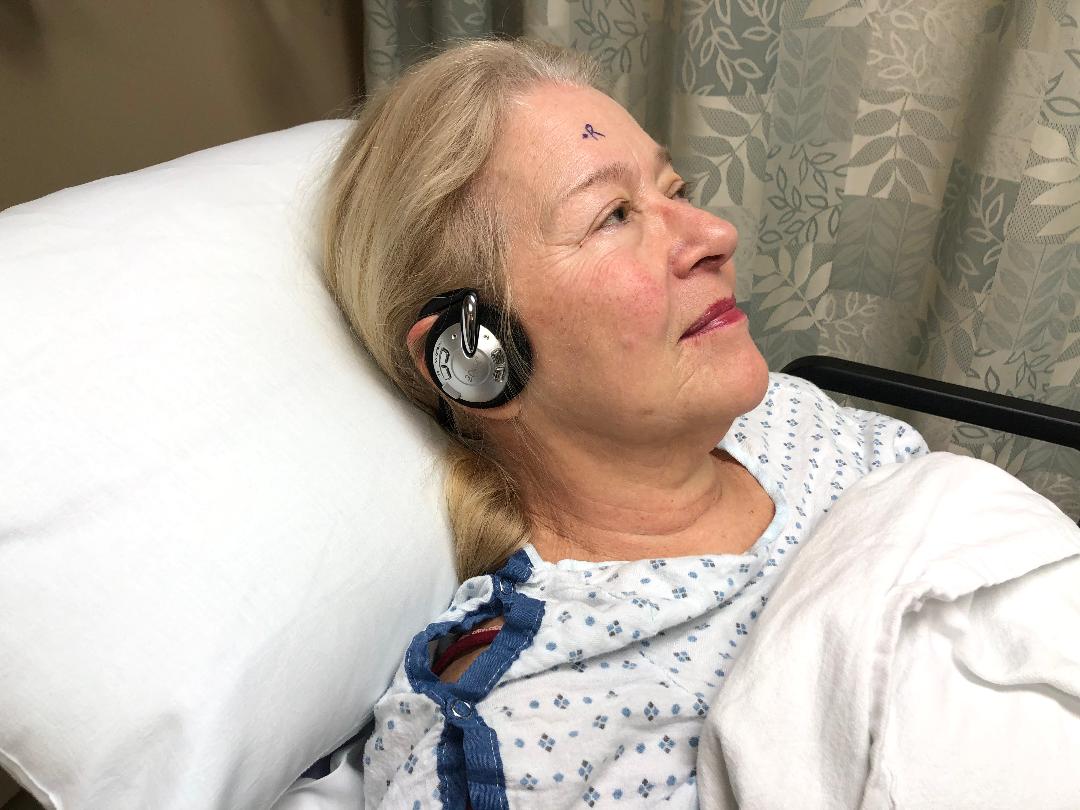
 So how does this apply to surgery?  One of the reasons that music is so powerful during surgery is that the pulse of the music entrains your heartbeat and breathing, even when you’re under general anesthesia.  Many people believe that when you’re under anesthesia you can’t actually “hear” the music.  That’s where the difference between entertainment and  entrainment comes in.

The idea began to take shape in my mind that some people in comas had been observed for years, tapping a toe or foot or finger, in rhythm with music being played or sung in the room.  Some people would awaken from lengthy comas, reporting that they ha indeed heard and appreciated music that was played or sung to them while in a coma.

After researching similar phenomena during surgery, I found that hundreds of people each year awaken from general anesthesia saying that they heard not only conversations during their surgery, but also music that was being played through speakers.  They also heard, during certain surgeries, the sound of drills, hammers and saws!!  This is when I began wondering if music that would start the entrainment process, played through super-lightweight headphones, might not be a wonderful thing.

Today, our Surgical Serenity Solution consists of just that.  After researching the very best music for entrainment, I have come up with a playlist that is soothing, comforting, and starts the entrainment process.  If you are having surgery in the near future, please consider getting yourself some!


FacebooktwitterpinterestlinkedinmailFacebooktwitterpinterestlinkedinmail
Apr Apr 4, 2014

Surgery with Music: FAQ’s

By |April 4, 2014|Anesthesia, Characteristics of music for surgery, Common Fears in Surgery, Dangers and Side-effects of anesthesia, Headphones for other medical procedures, How music works, Music and Anesthesia, Surgery Music|0 Comments

FacebooktwitterpinterestlinkedinmailFacebooktwitterpinterestlinkedinmail

Are you having surgery?  Are you scared of the pain, the anesthesia, the time off work, the side-effects of all the medications you’ll be given?  These are all common, and VALID concerns.  Surgery is serious business, but there are times that it really must be done to improve quality of life, to prolong life, or to enhance life.

Over the past 5 or 6 decades, surgery has become a much safer endeavor as hospital OR conditions have improved and methods of sterilization and decontamination have stepped into the 21st century.  Many companies have created tools to make the patient more comfortable during the entire procedure, from warming the sheets and giving the patient fuzzy foot-cover, to lightweight headphones that deliver specially-chosen music for surgery, wirelessly and cordlessly!

Here are some of the most frequently-asked questions that I get about the benefits of music during surgery:

  1. What are the benefits of music during surgery:

Patients using music (through cordless headphones) pre-surgery, during and after surgery, report less fear and anxiety medication before procedure, less anesthesia during surgery, and less pain medication after surgery.  They also report fewer side-effects from the anesthesia, such as nausea and vomiting, and a faster return to home, work and life in general!  In addition, when patient receives the music through headphones, the surgeon can have his own more upbeat music, and the patient isn’t affected by that.  Also, conversations that the doctors and nurses have, that patient doesn’t want to hear, will be obscured.  Finally, with Baby boomers having more and more joint replacement surgeries, patients don’t have to hear the drilling, sawing and hammering that goes on.

2.  What are the drawbacks of music during surgery:  absolutely none!

3.   Do the headphones block all sounds in the OR?:  No, the surgical headphones are intended to greatly decrease the OR noises, but during regional anesthesia and surgery, the patient can still hear questions that the doctor might need to ask.

4.   Will my doctors approve of this?  Most doctors do approve of the use of headphones during surgery.  The surgeon and the anesthesiologist both need to give their approval.  It is important to print out our free article entitled “How to Talk with Your Doctor about Using Music During Surgery.”

5.   How did you choose the music on the headphones?:  I have been helping patients choose their perfect music for surgery for almost 25 years.  I had been reading about the benefits of music in reducing medication and calming the patient, but through my own personal research and experience, I discovered that slow, steady, soothing instrumental music, that has the tempo of the healthy, resting heartbeat is ideal.  This is what get the entrainment process going, and even when the patient is under general anesthesia, the body’s heartbeat, breathing and blood pressure all tend to stabilize and synchronize with the slow, steady pulse of the music.

6.    Can I continue to use them after surgery?:  Yes.  The headphones include a USB cable and charger so that after your surgery or other medical procedure, you can connect the headphones to your laptop and load hundreds more pieces or songs of your choice.  With care, your headphones should last for many years!

FacebooktwitterpinterestlinkedinmailFacebooktwitterpinterestlinkedinmail
Feb Feb 14, 2014

Knee Replacement Surgery with Music

By |February 14, 2014|Common Fears in Surgery, Music and Anesthesia|0 Comments

FacebooktwitterpinterestlinkedinmailFacebooktwitterpinterestlinkedinmail

The aging baby-boomer population is filling up the hospitals nowadays.  Our joints, especially are simply wearing out and luckily, they can now be replaced!  Imagine what it was like when joints wore out and people just had to live with it.   Results of worn-out joints included becoming sedentary, depressed and eventually dying of pneumonia.  Of course this didn’t happen to everyone, but many people, for centuries, did have this happen.

We do live in a miraculous time!  With antibiotics, artificial knees and hips, and machines that can exercise our knees and our lungs for us, what more do we need?  I think that a great addition to this picture is music.

Ample research exists that document music’s beneficial effects before, during and after surgery.  When the music is delivered through cordless, pre-programmed headphones, it’s even better!  Recently I met with a lady who desperately needed knee replacement but was so fearful and anxious that she almost didn’t have the surgery.  She had heard about the Surgical Serenity Solution and because she lives here in Louisville, KY, I was able to hand-deliver them and talk with her about how different this would be from previous surgeries.

Listen as she describes what her experience was like:


FacebooktwitterpinterestlinkedinmailFacebooktwitterpinterestlinkedinmail
Jan Jan 7, 2014

Surgery with Music: What’s New in 2014

By |January 7, 2014|Music and Anesthesia, Music in the hospitals, Surgery Music|0 Comments

FacebooktwitterpinterestlinkedinmailFacebooktwitterpinterestlinkedinmail

It’s really exciting to see so many advances in surgery on the horizon, and although I don’t wish surgery on anyone, it definitely will be happening all day, every day, around the world.  What I am most interested in is seeing that everyone has the best possible chance for a positive outcome!

Many astute and perceptive surgeons and anesthesiologists have realized for a long time that music is a powerful and effective addition to the surgical suite, but most were not sure how best to implement this idea.  The idea of using lightweight, behind the neck headphones for the patient, while allowing ambient music delivery for the surgeon, is an ideal solution that will be seen more and more in 2014.

Some other new developments in general surgery include:

  • Intraoperative radiation therapy for newly diagnosed breast cancer (December 2013)
  • Tumor seeding following endoscopic ultrasound-guided fine-needle aspiration of pancreatic tumors
  • Bedside ultrasound prior to skin abscess draining.

Can you imagine how helpful the soothing music headphones could be for patients undergoing any of the above procedures.  And, of course, the calmer and more relaxed the patient is, the better the surgeon can do his or her job.  It just makes sense to relax the patient with music before, during and after any surgical procedure with a method that has no side-effects and reduces recovery time as well as nausea and vomiting.

For more information, see www.SurgicalSerenitySolutions.com or email me at DrAlice@surgicalserenitysolutions.com.


FacebooktwitterpinterestlinkedinmailFacebooktwitterpinterestlinkedinmail
Dec Dec 1, 2013

Surgical Serenity Solutions featured in local magazine

By |December 1, 2013|Anesthesia, Benefits of music during surgery, Fear of surgery, Headphones for other medical procedures|0 Comments

FacebooktwitterpinterestlinkedinmailFacebooktwitterpinterestlinkedinmail

FullSizeRender (3) Yes, I was thrilled when a local journalist wanted to write an article about Surgical Serenity Solutions.  One of the challenges that we musicians, music therapists, and clinical musicologists have is publicity.  In the past, unless one had a very healthy  marketing and advertising budget, it was just not possible to let the world know what all of the possibilities were for healing with music, how music affects the brain, and the tremendous benefits of music with surgery.  Now, much of that has changed!

With the internet and the world wide web, Surgical Serenity Solutions now has the possibility of electronic magazines (ezines), blogs, Facebook, Twitter and so much more.  All of these are basically free, but there is just a little bit of a learning curve.  Thanks to all of the new “social media” options, millions more people are now aware of the healing power of music.  And this week, out came one more great article about the Surgical Serenity Solution.  http://issuu.com/todayswoman.com/docs/todayswomandecember2013

The only way that we can get our wonderful, pre-programmed headphones into every hospital is to use social media to the max!  Surgical Serenity Solutions not only has a website, but also a blog, a FB page, www.facebook.com/surgicalserenitysolutions , a Twitter account, @music4surgery , a Instagram account, #surgicalserenitysolutions and other websites such as www.SurgicalHeadphones.com.  I do hope you’ll connect with us in as many of these venues as possible!

There is so much to understand about how to use music with your surgery and so much medical research to report on now!  Don’t miss out on this exciting new development in the world of surgery and the world of MusicMedicine.

Would love to get your comments and questions after reading  this!  Thanks!

FacebooktwitterpinterestlinkedinmailFacebooktwitterpinterestlinkedinmail
Oct Oct 30, 2013

New research study on the use of music and reassuring words during surgery

By |October 30, 2013|Anesthesia, Benefits of music during surgery, Common Fears in Surgery, Fear and Anxiety about Surgery, Fear of surgery, Power of Reassuring words and music!|0 Comments

FacebooktwitterpinterestlinkedinmailFacebooktwitterpinterestlinkedinmail

Just important might reassuring music or reassuring words be to you during the surgical process?  Quite a bit, according to a study that just came out of Sweden.   Why do people utter words of reassurance?  Why do people like hearing words of reassurance?  When undergoing a medical procedure that is potentially painful, we tend to give our power to the doctor and the medical staff.  If they reassure us that it probably will turn out well, or that the pain will be brief of even not that painful, we like that!

Add some soothing music to the formula and it’s going to be even better!  Check out this new study that verifies that this is really true!  🙂  Enjoy!

“(NewsFix) Women who heard relaxing music and reassuring words during an operation made a much better recovery than those who did not.
Although you are unconscious during surgery, the brain may still be aware – at some level – of what’s going on around you. Researchers at Orebro Medical Center Hospital in Sweden have demonstrated this to dramatic effect. A group of 90 women undergoing hysterectomies were assigned to either relaxing music, reassuring words and music, or the usual sounds of the operating theatre.

Those exposed to music along with the soothing sound of ocean waves – with or without reassuring words – experienced less post-operative pain and fatigue and were able to sit up sooner after surgery than those who did not hear music. They also felt better when they got home. But there were no benefits in terms of length of hospital stay, nausea or bowel function.

Since playing music and saying reassuring words is simple and inexpensive, there’s not reason not to try it out with all surgical patients, say the researchers. At the very least, it would blot out any worrying comments being made by the medical team which might be picked up – at some level – by the patient.”

FacebooktwitterpinterestlinkedinmailFacebooktwitterpinterestlinkedinmail
Sep Sep 26, 2013

Case History #8: 51 y.o.woman with hysterectomy

By |September 26, 2013|Anesthesia, Benefits of music during surgery, Dangers and Side-effects of anesthesia, Music and Hysterectomy|0 Comments

FacebooktwitterpinterestlinkedinmailFacebooktwitterpinterestlinkedinmail

One of the most interesting patients that I worked with was a 51 y.o. woman who was also a music therapist.    She loved music so much but suffered from severe performance anxiety and so she could never play for others and had gone into another helping profession.  However, her love of music was still intense and when she found that she could use the music she loved to help her through surgery, this is what she wanted to do!

She had been suffering from large fibroids, painful  and heavy menstrual periods since her teens and was now being told that she needed a complete hysterectomy so that she would not have to worry about the cervical cancer that had claimed her mother’s life.  Patient was extremely anxious about going under the knife, but believed that being able to listen to music as she went under general anesthesia and being able to wake up to the same gentle, rhythmic music would make it less terrifying for her.

On the day of the surgery, she was listening through her headphones from the moment she arrived at the hospital.  There was a bit of a glitch, she reported, when they finally took her back to be gowned and given an IV.  She said that having the soft, soothing music playing in her ears while they took her vital signs and asked a few last questions of her sister, was so comforting.

The surgery was a complete success and the patient reported that one of the best thing about having music was that it helped to orient her to where she was and what had just happened:  the surgery.  Despite rather bad nausea and vomiting in the ER, patient said that she still felt the music made it so much easier and more tolerable.  Remember, fear is necessarily about logic and even having lots of “head” information.  If you’re scared, you’re scared.  Let the music go in with you and comfort you…all the way!

FacebooktwitterpinterestlinkedinmailFacebooktwitterpinterestlinkedinmail
Sep Sep 21, 2013

Redheads and Anesthesia: There is a difference for them!

By |September 21, 2013|Anesthesia, Anesthesia and Redheads, Dangers and Side-effects of anesthesia, surgery preparation|2 Comments

FacebooktwitterpinterestlinkedinmailFacebooktwitterpinterestlinkedinmail
Redheaded woman

Yes, redheads do require more anesthesia

Anesthesia is a tricky thing.  And now that we have the internet you can literally scare yourself to death reading horror stories online about anesthesia mishaps, people who woke up during surgery or patients who had the wrong body part removed.  And now there’s something new to be concerned with.   Are you a redhead?  Are you about to have general anesthesia?  You may have heard that redheads require more anesthesia and after just a little bit of researching, you’ll find that it’s true!  Why?  Here’s what one researcher has to say:

Dr. Daniel I. Sessler, an anesthesiologist and chairman of the department of outcomes research at the Cleveland Clinic, said he began studying hair color after hearing so many colleagues speculate about redheads requiring more anesthesia.

“The reason we studied redheads in the beginning, it was essentially an urban legend in the anesthesia community saying redheads were difficult to anesthetize,” Dr. Sessler said. “This was so intriguing we went ahead and studied it. Redheads really do require more anesthesia, and by a clinically important amount.”

After publishing research on the topic, Dr. Sessler began hearing from redheads who complained about problems with dental pain and fear about going to the dentist. He said that when someone with red hair is considering a dental or other procedure requiring an anesthetic, they should talk to their doctor about the high probability that they are resistant to anesthetics.

“Because they’re resistant, many redheads have had bad experiences,” Dr. Sessler said. “If they go to the dentist or have a cut sutured, they’ll need more local anesthetic than other people.”

One of my redheaded friends was so relieved to hear this because she says now she won’t feel so bad when she tells the dentist that she can still feel what he is doing to her and yes, that she still does need more novocaine!  Hopefully, this will help many redheads to understand why they need more pain relief.

Which brings me to my next point.  If you are a redhead and need to have surgery ,are you concerned that you will require more anesthesia?  Fears about anesthesia include, being given too much anesthesia and not waking up afterwards; being given too little anesthesia and waking up before surgery is finished; being resistant to anesthesia and waking up enough to feel and hear what is happening but not being able to say anything.  Although all of these scenarios are extremely unlikely, they do happen and merit some careful thought about how to proceed.  Be sure to talk with your physician about your options.

After more research, I understand that it’s not that redheads are more resistant to anesthesia, but that they metabolize it faster and therefore need more anesthesia, analgesics, novocaine, or whatever it might be.  To order these headphones for YOUR hospitals, go to https://www.surgicalserenitysolutions.com/12-pre-loaded-headphones-for-hospitals/

listening to the calming, rhythmic entrainment music prior to surgery

Patient calms down before surgical procedure with music rather than benzodiazepines

Make sure that the patients at YOUR hospital have the very best and latest equipment to get them through their surgery or procedure with as little pain and discomfort as possible.  You can also let your patients know about our mobile app, which has 5 different, hour-long playlists, in 5 different genres, to get them through their procedures!  Just go to www.SurgicalSerenitySolutions.com/calm.

FacebooktwitterpinterestlinkedinmailFacebooktwitterpinterestlinkedinmail
Sep Sep 20, 2013

More Benefits for Music with Surgery: HIPAA compliance

By |September 20, 2013|Benefits of music during surgery, Surgical Headphones and HIPAA|0 Comments

FacebooktwitterpinterestlinkedinmailFacebooktwitterpinterestlinkedinmail

Today I was talking with a nurse at a large mid-Western hospital.  They had contacted me about buying our pre-programmed headphones for their surgery patients and I was answering her questions and beginning to understand what their specific needs were.  The nurse told me that they specifically wanted them for pre-surgery, because there were invariably a room full of patients waiting to be taken into surgery and that each was allowed to have two people with them.

Occasionally, the nurse went on, the room is crowded with surgical patients and one of them begins having a problem or an issue of one kind or another.  The nurses congregate at the one nursing station to discuss the patient/issue/medical crisis and all of the other patients and family members can easily hear the conversation!  Of course this is totally against HIPAA compliance with privacy and patient confidentiality.  In other words, one of the main reasons they wanted the Surgical Serenity Headphones was so that patients achieved privacy and sonic “space.”

When we look at benefits, we typically cite

  • reduced anxiety
  • stabilized blood pressure
  • stabilized breathing and oxygenation of blood
  • reduced anesthesia requirements
  • faster recovery for patient
  • less nausea and vomiting after surgery
  • back to work and life faster because of less medication

Now we have a new one:  better HIPAA compliance!  And that is truly a big deal.  I’ve worked at several different hospitals since HIPAA was put into law and I know that the fines for violating HIPAA laws are enormous.  Hospitals can even lose the accreditation is they repeatedly violate HIPAA laws and policies.  Very important!  Take note, hospital administrators!

FacebooktwitterpinterestlinkedinmailFacebooktwitterpinterestlinkedinmail
Go to Top