
Rave Reviews come in of my Surgery Headphones

FacebooktwitterpinterestlinkedinmailFacebooktwitterpinterestlinkedinmail


Well I had a wonderful experience tonight at a banquet I attended. I was not expecting to know many of the people who were there, but to my delight, there was a woman MD who bought my headphones a few months ago for her knee replacement surgery! I had not heard from her and although I try to follow up with all my customers, had not gotten back to her.
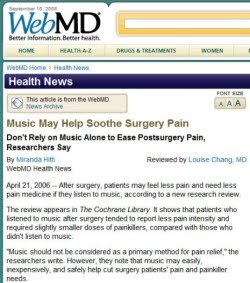
During the break before the speaker she saw me and came over to me with a BIG smile on her face. She said the the headphones did great and she was so thrilled the the doctors and nurses not only allowed her to wear them all the way through her surgery, but that they were quite excited and intrigued but the whole idea and said they had been reading about them! Needless to say, i was thrilled!

Who’s next??!!

FacebooktwitterpinterestlinkedinmailFacebooktwitterpinterestlinkedinmail

Music during Surgery: A video report

FacebooktwitterpinterestlinkedinmailFacebooktwitterpinterestlinkedinmail

This music was planned and played by my friend and mentor, Dr. Arthur Harvey. Since this was created, Dr. Harvey has moved from Honolulu to the Sarasota area. I will be in Sarasota from Oct. 22-26 and available to consult with folks about music during surgery. Let me know if you live in the area and would like to meet. More info to come! Stay tuned!

FacebooktwitterpinterestlinkedinmailFacebooktwitterpinterestlinkedinmail

Now anyone can have music during surgery!

FacebooktwitterpinterestlinkedinmailFacebooktwitterpinterestlinkedinmail

Research has proven beyond any doubt that music during surgery is a powerful adjunct. As my pre-programmed, cordless headphones hit the market, research studies in hospitals and clinics from around the world pour into medical journals about the benefits of music to the patient, during surgery! Surgeons have been using their own iPods and CDs during surgeries for a couple of decades, but the majority of people did not realize that the patient’s body was responding to the music too and that patient needed a very different type of music!

As a musicologist with clinical/hospital training I have chosen the perfect music for YOUR surgery. Get them now and be prepared! Send my surgical headphones now.

FacebooktwitterpinterestlinkedinmailFacebooktwitterpinterestlinkedinmail

More on Propofol

FacebooktwitterpinterestlinkedinmailFacebooktwitterpinterestlinkedinmail

Well, it looks like Michael Jackson’s personal 24/7 physician is the person who gave him the propofol that killed him.  There has been so much in the media that I don’t want to belabor this but needless to say, this man is in big trouble and will probably do prison time, not to mention never practicing medicine again!

So sad.  What do we do to our entertainers that makes them feel that they are so different that the rules for other humans just don’t apply to them?  Really tragic!
FacebooktwitterpinterestlinkedinmailFacebooktwitterpinterestlinkedinmail

Why Propofol should only be in the hospital

FacebooktwitterpinterestlinkedinmailFacebooktwitterpinterestlinkedinmail


Anesthesia in Jackson Case Tracked
Posted Jul 14th 2009 6:35PM by TMZ Staff

We’ve learned several pharmaceutical companies have been contacted by the DEA in the Michael Jackson case and we’re told authorities are getting closer to identifying which person may have supplied the powerful anesthesia Propofol that appears to have killed the singer.

Sources tell us law enforcement found vials of Propofol in Michael Jackson’s house after he died. The vials all have lot numbers. We’re told several days ago the DEA contacted Teva Pharmaceuticals — which manufactured one of the vials found at the house — to determine who purchased it.

Teva sells Propofol to medical distributors, who then turn around and sell the vials to hospitals and doctors.

And, law enforcement sources say, the DEA also contacted other manufacturers of Propofol from the other vials found in Jackson’s home.

Here’s the problem. Although every vial has a lot number, the vials are not marked individually. There are thousands of vials in a lot. So the DEA and LAPD are trying to hone in on the culprit but, we’re told, it’s no easy task.

FacebooktwitterpinterestlinkedinmailFacebooktwitterpinterestlinkedinmail

Surgery with music lectures for your organization

FacebooktwitterpinterestlinkedinmailFacebooktwitterpinterestlinkedinmail

The word about music during surgery is getting out! I did a lecture this past Friday night at a large Presbyterian Church here in Louisville and then appeared on a widely-broadcast radio show here earlier this evening!

Once people begin to understand what a huge benefit music during surgery is, the more they not only use it themselves for any medical procedure but the more they begin to tell their friends, family, and physicians. My goal is to have the wireless, pre-programmed headphones in every hospital, every doctor’s office and in many homes as well.

If you want to know more, go now to www.surgicalheadphones.com. As always, send me your questions, your comments, and your stories of music’s healing power.

FacebooktwitterpinterestlinkedinmailFacebooktwitterpinterestlinkedinmail

A little humor regarding effects of surgery!

FacebooktwitterpinterestlinkedinmailFacebooktwitterpinterestlinkedinmail

This blog is a serious blog. My intent is to impart as much scientifically grounded information to you as possible regarding the use of music with surgery and other medical situations. But every now and then something really funny comes along:
“LOS ANGELES—Leave it to Robin Williams, who is recovering from his heart surgery last March, to liven up the proceedings at the recent premiere of “Night at the Museum: Battle of the Smithsonian” in Washington, DC.”
Hope you’re staying cool and comfortable wherever you are!
FacebooktwitterpinterestlinkedinmailFacebooktwitterpinterestlinkedinmail

How does anesthesia work?

FacebooktwitterpinterestlinkedinmailFacebooktwitterpinterestlinkedinmail

Many inventions of the 19th century — telephones, airplanes, phonographs — have helped to shape the modern world. However, it could be argued that the 1846 discovery of effective surgical anesthesia holds a place of honor among the century’s advances.

Music for Surgery Headphones now available!

Use Less Anesthesia by adding music

Prior to the advent of effective anesthetics, surgery was a desperate last resort that used crude and dangerous means (including large doses of opium or alcohol, or knocking a patient unconscious) to dull the patient’s sensations. Today, whether it is a shot of novocaine at the dentist, a spinal or epidural during childbirth, deep sedation for a minor procedure or general anesthesia for major surgery, the use of effective anesthesia is a routine part of medical care.
Although most of us have experienced anesthesia, the general public has little understanding of what it is and how it works. According to Steve Kimatian, associate professor of anesthesiology and pediatrics in Penn State’s College of Medicine, anesthesia is not a single entity, but rather a manipulation of several physiological functions of the body.

“In its most basic sense, you can say that anesthesia consists of four components: hypnosis, amnesia, analgesia and muscle relaxation,” explained Kimatian.
These components — which range from local anesthetic injections to regional anesthetics (such as spinal and epidural) to general anesthesia — may be combined or used separately depending on the type of surgery and patients’ needs.

While you may have thought you were “asleep” for that tonsillectomy as a teenager, technically you were in a state of deep hypnosis. When you finally woke up in the recovery room, you probably didn’t remember anything about the surgery — thanks to the effects of amnesia-inducing agents you were given.

But Kimatian explains that sedation and amnesia do not necessarily mean the same thing. You can be “asleep” during a procedure but afterwards remember hearing the voices of the doctors or you can also be “awake” during a procedure, speaking with the doctors, answering questions and following commands, but remember nothing.
Said Kimatian, although you don’t remember having any pain during the surgery, that doesn’t necessarily mean the pain wasn’t there.

“A person can be sedated and appear to be asleep, they can be amnesic and not remember anything, but their body can still have a physiological response to a stimulus. Consider the tree falling in the forest analogy. If you had pain and you don’t remember it, did you really have pain? From an anesthesiologist’s standpoint, yes, because we have to address those physiologic changes that occur with response to stimulus.”

In cases requiring regional anesthesia, how do anesthesiologists block sensation to specific body parts and not others?

Explained Kimatian, if we touch a hot stove, thermal receptors in our hand send an electrical signal to our spinal cord which signals our brain, and we react by experiencing pain and removing our hand from the stimulus. To make sure we don’t feel the pain during a surgery or procedure, an anesthesiologist uses analgesics or local anesthetics to block the signal somewhere between the point of the stimulus and the brain.

“I could do a regional anesthetic selective to an individual finger, by just blocking the nerves of that digit, and you wouldn’t know the finger was in pain,” Kimatian said. “Or you can block all the nerves to the forearm so you wouldn’t feel the pain there. You could block it at the shoulder. You could block it at the epidural space where the nerves enter into the spinal sac, or you can put the person completely to sleep and block it at the cerebral level.”

The art and science of anesthesia, said Kimatian, is knowing how to tailor both the technique and the dosage to the individual patient’s needs. “Understanding the delicate balance between desired effects and undesired side effects requires a physician’s in-depth knowledge of physiology and pharmacology,” he added.
Source: by James Conroy, Research Penn State

FacebooktwitterpinterestlinkedinmailFacebooktwitterpinterestlinkedinmail

Understanding the Power of Entrainment

FacebooktwitterpinterestlinkedinmailFacebooktwitterpinterestlinkedinmail

One of the most frequent questions that I get about my music with surgery process and headphones is “how do you know this works?” That’s a great questions and very important to understand that this is not just a hunch I have!

When I began studying music therapy back in 1990 with Laurie Rugenstein, one of the first things I learned about was the power of musical entrainment. To make it as simple as possible ” when people hear rhythmic music being played, they automatically begin to tap a toe, tap a finger, nod their head, or sometimes, get up and dance!

Now what does this have to do with surgery? Well, music therapy and medical research (http://www.pubmed.com/) databases are filled with scientific, empirical studies documenting that when rhythmic music is played for patients, their heartrate and breathing tend to synchronize with that music, often lowering blood pressure, lowering heart rate, stabilizing body temperature and all biorhythms.

Many of these studies played the music through headphones which not only delivers the music directly to the brain through the 8th cranial nerve, but also drowns out OR conversations, and sounds that the patient might not want to hear like drilling, sawing, and breaking bones!

The headphones that I have created are wireless, cordless, and completely re-chargeable. They hold 7-8 hours of specially-selected music for surgery or can be programmed with the music you choose!

Learn more about surgical headphones

FacebooktwitterpinterestlinkedinmailFacebooktwitterpinterestlinkedinmail

What is the advantage of using “musical anesthesia?”

FacebooktwitterpinterestlinkedinmailFacebooktwitterpinterestlinkedinmail

What exactly is “Musical Anesthesia?”  This is my patented procedure for using music during surgery (or other medical procedures) wherein the patient has specially created wireless headphones that deliver specially chosen music during surgery for the express purpose of reducing (sometimes dramatically) the amount of anesthesia required during the procedure.

Why would someone want to reduce the amount of anesthesia they require during surgery? Anesthesia-related complications range from headache to death.  Although people do not die very often from anesthesia, it does happen every year because of previously unknown allergies, anesthesia-related heart attacks, and other unforseen events that result in death.
If you knew that you could supplement the usual anesthesia with music in order to create a safe experience, wouldn’t you want to do that?  I have created a patented a process to deliver that perfect music for surgery through wireless headphones.

 If you want to know more about this, please click HERE.  Thank you!

FacebooktwitterpinterestlinkedinmailFacebooktwitterpinterestlinkedinmail
Go to Top